
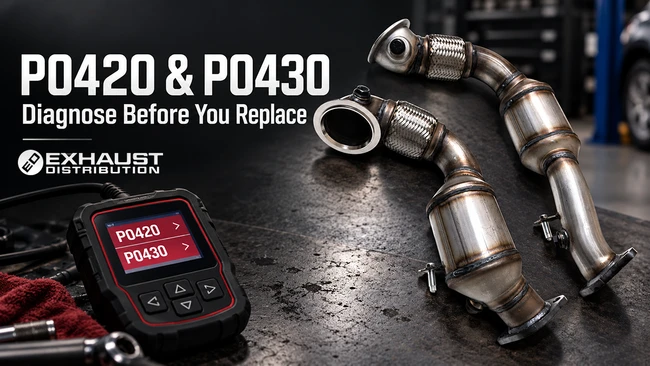
A check-engine light and a P0420 or P0430 code can leave you wondering whether an expensive catalytic converter replacement is unavoidable.
These codes deserve attention, but the most useful next step is a diagnosis. Before ordering a converter, find out what the vehicle’s computer detected, whether other faults are present, and what testing supports the recommended repair.
This guide from Exhaust Distribution explains how to approach that conversation with your repair shop and avoid choosing parts based on a code alone.
What do P0420 and P0430 mean?
Both codes describe catalyst efficiency below the vehicle’s programmed threshold:
| Code | Description |
|---|---|
| P0420 | Catalyst system efficiency below threshold — Bank 1 |
| P0430 | Catalyst system efficiency below threshold — Bank 2 |
Ford’s technical documentation uses these definitions and shows that catalyst monitoring depends on operating conditions and related diagnostic checks. A code identifies the monitored system; it does not provide a replacement part number.
Ask your technician to identify the affected converter using the service information for your exact vehicle. Bring the complete scan report when discussing the repair.
Start by recording the evidence
Before clearing the check-engine light, ask the shop to save the trouble codes and available freeze-frame data—the snapshot of operating conditions recorded with a fault.
Useful questions include:
- Is P0420 or P0430 the only code?
- Are there pending codes as well as confirmed codes?
- Did the fault appear before or after recent repairs?
- What testing will distinguish a converter problem from a sensor, engine, or exhaust problem?
Identifix’s diagnostic guidance recommends reviewing freeze-frame information and live operating data, including fuel trims, when investigating P0420.
Keep your repair invoices together. A clear timeline makes it easier to explain whether the light appeared after an exhaust repair, an engine problem, or a previous converter replacement.
Address other engine faults first
If the scan also shows misfire codes, those deserve investigation before the converter’s condition is judged. Walker’s P0420 diagnostic procedure specifically begins with resolving other engine trouble codes, particularly the P0300 series associated with misfires.
This matters because abnormal engine operation can damage a converter. Walker identifies overheating, contamination, and structural damage among major converter failure categories. Misfires and combustion problems can contribute to excessive converter temperatures.
A useful question for your repair shop is:
“If the converter has failed, what evidence explains why, and does anything else need repair before the new part is installed?”
The answer helps you understand the complete repair instead of evaluating only the converter’s price.
Have the exhaust checked for leaks
An exhaust leak can affect oxygen-sensor readings and complicate catalyst diagnosis. Walker recommends examining welds, sensor ports, pipe connections, gaskets, clamps, and flex-pipe sections during the diagnostic process.
Ask the technician to document any leak and explain its location. If a leak is repaired, ask how catalyst performance will be reassessed afterward.
If the diagnosis identifies a damaged flex section, you can browse Exhaust Distribution’s exhaust flex pipes. Confirm the required component with your installer before ordering; a catalyst code alone does not establish which pipe or assembly needs replacement.
Test the sensors before replacing them
Oxygen sensors supply information used in catalyst monitoring, but replacing sensors simply because P0420 appears is another form of guessing.
A technician should evaluate the relevant sensor response and associated circuits using the vehicle’s diagnostic procedure. Sensor types and monitoring strategies differ, so a graph or voltage rule from another vehicle may not apply. Identifix specifically cautions against treating one waveform pattern as a universal diagnosis.
Before approving sensor replacement, ask:
“Which test showed that this sensor or its circuit is faulty?”
The goal is a repair recommendation supported by an identifiable test result.
Check for vehicle-specific service guidance
A generic code description is only the beginning. Manufacturer service bulletins can identify a specific diagnostic or repair procedure for certain vehicles.
For example, Ford issued a bulletin addressing P0420 and/or P0430 on some 2020–2021 Expedition and Navigator vehicles, describing a possible relationship with sulfur in the fuel and prescribing a particular service procedure. That example applies only to vehicles meeting the bulletin’s criteria. It illustrates why the shop should check applicable manufacturer guidance before deciding on replacement.
Ask whether any relevant bulletin, calibration guidance, or campaign applies to your VIN. Do not assume a procedure found for another model also applies to yours.
What to request before ordering a converter
Once testing supports catalytic converter replacement, ask for a written estimate that identifies the component and the work included.
Use this checklist when reviewing the recommendation:
| Ask for | Why it is useful |
|---|---|
| The affected converter’s location | Makes the proposed replacement unambiguous |
| The test findings | Explains why replacement is recommended |
| Any related repairs | Clarifies the complete scope of work |
| The proposed part number | Gives you something precise to verify |
| Included installation items | Helps compare estimates consistently |
| The verification plan | Establishes how the repair will be checked |
You can then review Exhaust Distribution’s catalytic converter listings. Confirm the exact application and applicable emissions requirements before purchasing.
For a broader explanation of selecting a replacement, read our Catalytic Converter Buying Guide.
Verify the repair after installation
Clearing a code is not proof that the underlying problem has been corrected.
OBD readiness monitors report whether the vehicle has completed its diagnostic checks. Clearing diagnostic trouble codes resets monitor status, and the conditions needed to complete the checks vary by vehicle and monitor.
Ask the shop to explain:
- Which checks were completed after the repair.
- Whether any relevant codes returned.
- Whether the catalyst monitor completed.
- Whether additional follow-up is needed.
Avoid treating a promised number of miles as a universal verification method. Follow the procedure appropriate to the vehicle, and check the actual diagnostic results.
Frequently asked questions
Does P0420 automatically mean I need a new catalytic converter?
No. Converter deterioration is one possibility, but diagnosis should also consider related engine faults, exhaust leaks, sensor operation, and vehicle-specific guidance. Replacement should follow the findings.
Can an exhaust leak contribute to a catalyst-efficiency code?
Yes. Leaks can affect the oxygen readings used during diagnosis. That is why exhaust inspection is part of Walker’s recommended diagnostic process. Repairing a leak does not, by itself, establish that the converter is healthy.
Why might the code return after converter replacement?
Possible explanations include an unresolved underlying fault or a problem that was not identified during the original diagnosis. Ask the shop to review the original test results, installation, and related systems. Walker stresses identifying and repairing the cause of converter failure before fitting a replacement.
Does an extinguished check-engine light mean the vehicle is ready for an emissions inspection?
Not necessarily. The relevant readiness checks may still be incomplete, particularly after codes have been cleared. Check monitor status and your inspection program’s requirements before booking a test.
What should I send when asking about a replacement part?
Prepare the vehicle’s year, make, model, engine information, VIN, the installer’s description of the required assembly, and any proposed part number. Include photographs if they help explain the component you are replacing. Ask for application confirmation before placing the order.
Plan your next step with Exhaust Distribution
Start with a documented diagnosis, then match the confirmed repair to the appropriate component. Explore our catalytic converters and exhaust flex pipes once your installer has identified what the vehicle needs.