
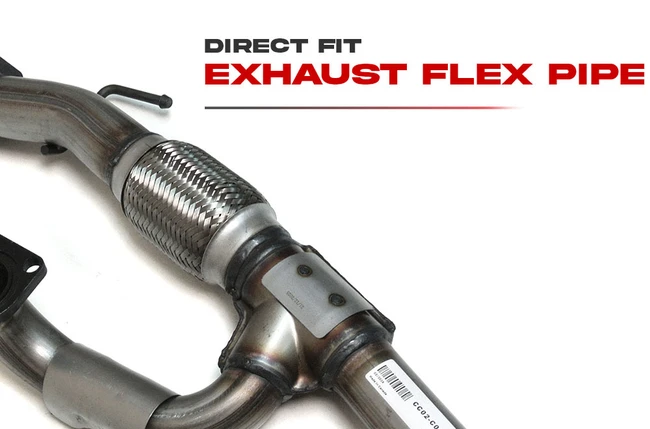
A louder exhaust does not automatically mean you need a new muffler or catalytic converter. A damaged exhaust flex pipe can also be the source of a leak. Before ordering replacement parts, identify which section has failed and whether your vehicle needs a separate flex connector, a front pipe assembly, or an assembly that includes a catalytic converter.
This guide explains what an exhaust flex pipe does, what to check when a leak is suspected, and how to compare replacement options. When you are ready to shop, browse exhaust flex pipes and related assemblies at Exhaust Distribution and match the individual listing to your vehicle.
What does an exhaust flex pipe do?
An exhaust flex pipe is a flexible connection within the exhaust system. It accommodates movement and helps isolate vibration between connected sections. The term “flex pipe” can describe the flexible connector itself or a larger replacement pipe assembly containing that connector.
That distinction matters when buying parts online. Two listings may both mention a flex pipe while supplying very different components. One may be a short connector intended for fabrication; another may include shaped tubing, flanges, mounting points, or a catalytic converter. Compare what is included before comparing prices.
Signs that an exhaust flex pipe needs inspection
Noise, visible damage, and a suspected leak are reasons to arrange an exhaust inspection. They are not enough on their own to identify the exact replacement part.
A change in exhaust sound
New blowing, hissing, or unusually loud exhaust noise can indicate a leak. Ask the technician to locate its source rather than assuming the muffler has failed. A connection or nearby pipe can produce a similar complaint.
Visible deterioration around the flex section
Ask the shop to check the flex section, adjoining tubing, and connections for damage. A worn-looking outer surface is useful evidence, but the repair decision should be based on the condition of the assembly and whether it leaks.
A warning light alongside an exhaust problem
If the check-engine light is on, record the diagnostic codes and have the cause investigated. Do not select a flex pipe or converter solely because a scanner reports a catalyst-related code. The code and the physical inspection need to be considered together.
Safety: If exhaust fumes enter the passenger compartment, stop using the vehicle and arrange professional inspection. Do not inspect underneath a vehicle supported only by a jack, and allow exhaust components to cool before handling them.
Confirm the leak before buying a replacement
Walker’s exhaust inspection guidance identifies the flex pipe as an area to check for leaks and emphasizes checking the wider system for additional problems. A repair estimate is more useful when it identifies both the failed component and the condition of the surrounding parts.
Ask these questions before approving the repair:
- Is the leak in the flexible section, an adjacent pipe, or a connection?
- Is the surrounding metal suitable for the proposed repair?
- Does the replacement need new gaskets, fasteners, or other hardware?
- Are there other damaged components that should be addressed during the same job?
- Will the shop install a separate connector or replace the complete assembly?
Request a photograph showing the failed section and its connections. Keep it alongside your vehicle details when comparing listings or asking for fitment assistance.
Separate flex connector or complete pipe assembly?
The best replacement choice depends on the confirmed damage, the available parts, and the installation method your repair shop recommends. Use the comparison below as a buying checklist.
| Option | What to confirm | Question for your installer |
|---|---|---|
| Separate flex connector | Diameter, overall length, flexible-body length, end configuration, and intended installation method. | Can this connector be installed correctly into the existing pipe? |
| Vehicle-specific pipe assembly | Application details, routing, flange positions, mounting points, and included hardware. | Does this replace the complete damaged section? |
| Assembly including a catalytic converter | Exact vehicle application, converter position, product restrictions, and suitability for the vehicle’s emissions configuration. | Is this the correct assembly for the repair, and what else is required? |
A lower-priced connector may involve fabrication labor. A complete assembly may include more components than the damaged flex section alone. Ask for an installed estimate for each suitable option so you can compare the total job.
How to check exhaust flex pipe fitment
Begin with the vehicle information, then check the listing’s application notes and component details. A product photograph is a comparison aid; it does not replace a fitment check.
1. Record the vehicle’s exact configuration
Have the year, make, model, and engine size ready. Include drivetrain, body style, transmission, and production information where the listing distinguishes between them. Keep the VIN available if additional identification is needed.
2. Identify the section being replaced
Use the technician’s description to establish the required pipe position and whether the part is a standalone pipe or a combined assembly. Do not assume that every listing containing your model name replaces the same section.
3. Compare the connections
Review the flange arrangement, pipe routing, mounting points, and sensor provisions shown or described. If something differs from your original assembly, ask for clarification before ordering. Do not plan to force a part into position to compensate for a mismatch.
4. Check dimensions when buying a universal connector
Ask the installer to specify the required measurements and connection style. Confirm whether a listed diameter refers to the inside or outside measurement, and whether the length describes the flexible section or the complete connector. A listing without enough information needs clarification.
5. Confirm hardware and installation requirements
Check what comes in the box. Ask whether the job requires separate gaskets, bolts, clamps, or fabrication. Walker’s installation troubleshooting guidance highlights the importance of catalog information, part compatibility, and correct hardware installation.
Does a leaking flex pipe mean the catalytic converter is bad?
No. A flex pipe leak does not by itself establish that the catalytic converter has failed. Walker’s checks before replacing a catalytic converter specifically call attention to flex pipes and explain that exhaust leaks can allow oxygen into the system.
If your vehicle has P0420 or P0430, have the leak and diagnostic findings evaluated before deciding which parts to replace. Repairing a leak is not a promise that a warning light will stay off; additional diagnosis may still be necessary.
For a broader explanation of converter selection and vehicle fitment, read our catalytic converter buying guide.
What affects exhaust flex pipe replacement cost?
There is no single useful price for every flex pipe repair. Request an itemized quote based on your vehicle and the confirmed damage.
- Part scope: A connector, a formed pipe, and a converter assembly are different purchases.
- Installation work: Ask whether fabrication or removal of adjoining components is included.
- Existing condition: Ask how damaged connections or hardware could affect the estimate.
- Additional supplies: Confirm gaskets and installation hardware.
- Purchase terms: Review shipping, taxes, returns, and the specific product’s warranty before ordering.
A practical request to a repair shop is: “Please identify the leaking section and quote the complete repair, including the part, hardware, labor, and any additional work you can already see is required.”
Frequently asked questions
Is a flex pipe the same as a catalytic converter?
No. The flexible connection accommodates movement; the catalytic converter is an emissions-control component. A replacement assembly can contain both, so read the contents and application details carefully.
Can I buy a flex pipe using only my vehicle’s year and model?
Use those details as a starting point. Verify the engine and any additional application distinctions in the listing before purchasing.
Does a direct-fit assembly always include installation hardware?
Check the individual listing. Do not assume gaskets, bolts, or clamps are included because the part is described as direct-fit.
Can I choose a universal flex connector by its appearance?
No. Have your installer confirm its dimensions, connections, and suitability for the intended repair before buying.
Should I replace the converter whenever I replace the flex pipe?
Base the decision on diagnosis and the vehicle’s assembly design. A damaged flex section alone does not prove that a converter needs replacement.
What should I send when asking about fitment?
Send the year, make, model, engine, relevant configuration details, and the product number you are considering. A clear photograph of the existing assembly and the technician’s repair description can help resolve uncertainty.
Find the right exhaust flex pipe for your repair
Start with a confirmed diagnosis, identify the required assembly, and verify the application before ordering. This gives your installer a clear parts plan and helps you avoid buying a component that does not match the job.
Shop exhaust flex pipes and related assemblies at Exhaust Distribution. Review the fitment notes, included components, and installation requirements on the individual product page before checkout.