
A detailed guide from Exhaust Distribution
A replacement catalytic converter should match your vehicle, its emissions requirements, and the specific section of exhaust being repaired. Getting those details right matters more than choosing a part that looks similar in a photograph.
Whether you are investigating a check-engine light, replacing a stolen converter, or planning a repair to a leaking exhaust assembly, a little preparation can prevent ordering mistakes and repeat labour. This guide explains what to check, how to compare replacement options, and which questions to ask before buying.
Exhaust Distribution offers catalytic converters and exhaust flex pipes, with vehicle browsing to help you begin your search. Use the catalog alongside the individual product’s fitment notes and your installer’s diagnosis to identify the appropriate replacement.
What Does a Catalytic Converter Do?
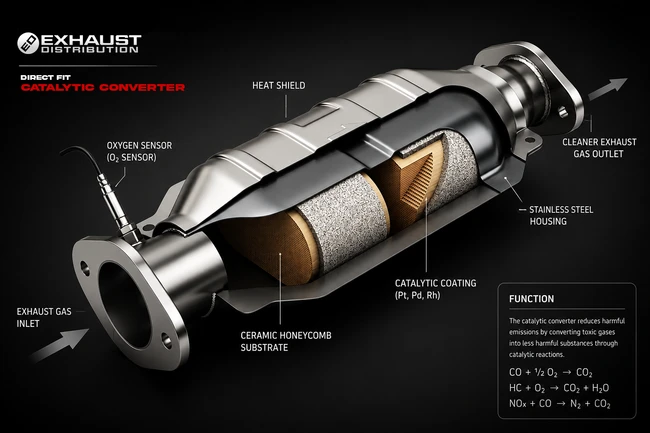
A catalytic converter treats exhaust gases before they leave the vehicle. In a typical gasoline three-way system, catalytic reactions reduce carbon monoxide, unburned hydrocarbons, and nitrogen oxides, producing carbon dioxide, water, and nitrogen. It reduces specific pollutants; it does not make exhaust harmless.
Inside the housing is a substrate that provides surface area for the catalyst coating. The assembly also includes supporting materials, and may incorporate heat shields and attached pipes. Oxygen sensors provide information used by the vehicle’s engine-management and emissions-monitoring systems. Technical reference: catalytic converter components.
For buyers, the important distinction is between the converter itself and the complete replacement assembly. One listing may cover a converter body, while another includes a manifold, formed tubing, or a flex section. Compare the boundaries of the repair with the components included in the listing.
Start With Diagnosis Before Buying a Replacement
A warning light or unusual exhaust noise gives you a reason to investigate. It does not identify every part that needs replacing.
Ask your repair shop for a written diagnosis that identifies the failed component and its location. A useful estimate should distinguish between a catalyst-efficiency problem, a restriction, physical damage, and an exhaust leak. It should also explain whether another engine or exhaust issue needs attention before the new part is installed.
Understanding P0420 and P0430
P0420 refers to catalyst-system efficiency below the monitoring threshold on Bank 1; P0430 refers to the corresponding condition on Bank 2. These codes help direct diagnosis, but they are not a complete parts order.
Diagnosis should address other engine fault codes, especially misfires, and check for exhaust leaks before condemning the converter. A technician can evaluate sensor information and perform appropriate catalyst tests using the vehicle manufacturer’s procedures. Technical reference: diagnosing catalyst-efficiency faults.
When requesting a quote, provide all recorded codes and the shop’s findings. “P0420 plus a confirmed failed front converter” is more useful than “check-engine light.”
Noises, Damage, and Changes in Performance
Describe what you notice without assuming the cause. Tell the technician when a rattle occurs, whether exhaust noise changed suddenly, and whether the vehicle’s response under acceleration has changed. Photographs of visible damage can help with parts identification, but an inspection is still needed to define the repair.
Ask the shop to identify the source of a noise before ordering an entire assembly. A loose shield, damaged connection, and failed converter may call for different repairs.
How to Choose the Correct Catalytic Converter
Treat fitment as a checklist. A match on year, make, and model is a starting point; the detailed application notes determine whether a particular part is appropriate.
1. Confirm the Vehicle and Engine
Have the following information available:
- Model year, make, and model.
- Engine displacement and fuel type.
- Relevant engine code or production-date information, if requested.
- Drivetrain configuration, including front-, rear-, or all-wheel drive.
- VIN for a private fitment inquiry with the seller or installer.
- Emissions-label information.
- The diagnosed converter position.
For example, a listing for a particular model with a four-cylinder engine should not be assumed to fit the same model with a V6. Likewise, do not extend a listing’s model-year range because a vehicle’s exterior appears unchanged.
2. Identify the Converter Position
Read terms such as front, rear, manifold, underbody, left, right, Bank 1, and Bank 2 carefully. They describe different aspects of the vehicle’s layout and are not automatically interchangeable.
Ask the installer to confirm the replacement position in writing. If the shop uses a bank designation and the catalog uses a side or location description, resolve that difference before ordering. Avoid assuming that Bank 1 always means the driver’s side.
3. Check the Emissions Label
Record or photograph the vehicle’s emissions-control information label, commonly located in the engine compartment. Use its information alongside the application listing and the rules where the vehicle will be registered and operated.
Do not assume that physical compatibility establishes emissions compliance. The EPA’s aftermarket converter guidance emphasizes selecting an appropriate application and maintaining the required converter configuration. Source: EPA aftermarket catalytic converter guidance.
4. Compare Connections and Included Components
Review the number and location of sensor ports, flange shapes, attached pipe routing, mounting brackets, and the overall assembly shown in the listing. Use photographs to support the fitment information, not to override it.
Confirm exactly what is included. Gaskets, bolts, clamps, oxygen sensors, and heat shields should only be treated as included when the product description says so. If a required item is not listed, ask before placing the order.
Direct-Fit vs. Universal Catalytic Converters
A direct-fit catalytic converter is designed around specified vehicle applications and connection points. A universal converter requires the installer to determine the appropriate application and integrate it into the exhaust system, commonly through cutting and welding.
| Buying consideration | Direct-fit converter | Universal converter |
|---|---|---|
| Selection | Match the detailed vehicle application | Confirm application suitability and installation dimensions |
| Connections | Designed for specified vehicle connection points | Installation usually requires fabrication |
| Attached components | May include formed pipes, brackets, or a manifold | Often supplied as a converter body with inlet and outlet connections |
| Quote comparison | Confirm labour and any additional hardware | Include fabrication and related installation materials |
| Main ordering risk | Missing an application restriction | Assuming a dimension match establishes suitability |
A universal converter does not fit every vehicle. The word describes the installation format, not unrestricted compatibility or approval.
For a direct-fit repair, ask whether the vehicle still has its original connection layout. Previous exhaust modifications may affect how a cataloged assembly can be installed. A bolt-on design also does not guarantee that old fasteners will remove easily or that adjacent parts are reusable.
Compare the total installed cost of the suitable options. A lower-priced component may require more labour, while a larger assembly may replace sections the shop would otherwise need to repair separately. Let the diagnosed repair scope guide the comparison.
OEM, Aftermarket, and Product Grade Descriptions
When comparing listings, separate three questions: who supplied the part, which vehicle it fits, and which emissions application it is approved or represented for.
An aftermarket part can be designed for a specific vehicle without being a vehicle-manufacturer-branded part. Similarly, terms such as “OEM grade” or “premium” should lead you to read the supporting specifications. They do not, by themselves, establish original-equipment identity, legal suitability, or identical construction.
Use this comparison method:
- Identify parts that match the complete vehicle application.
- Exclude options that do not satisfy the applicable emissions requirements.
- Compare the assembly contents and installation needs.
- Read the written warranty and return conditions.
- Compare the complete repair cost.
This approach keeps marketing labels from becoming a substitute for a verified part match.
Emissions Requirements in the United States and Canada
U.S. Federal Requirements
For U.S. applications, verify that the replacement meets the applicable aftermarket converter requirements and is selected for the correct vehicle. Keep the product identification, invoice, and installation documentation. The EPA’s guidance addresses application selection, installation, labeling, and recordkeeping. Source: EPA aftermarket converter policy.
Do not treat a broad “EPA” description as permission to use the part in every jurisdiction. Confirm the requirements for the actual installation.
California Applications
California’s Bureau of Automotive Repair states that a replacement must be an appropriate OEM converter or a CARB-approved aftermarket converter with an Executive Order number meeting the vehicle’s exact requirements. Check both the part and the approved application. Source: California BAR replacement guidance.
CARB provides an aftermarket catalytic converter database and links to approval information. A general reference to CARB approval is insufficient if the specific application does not match. Source: CARB aftermarket catalytic converter database.
For other states, check current state requirements before purchase rather than relying on a fixed list in an older article.
Canadian Applications
Canadian buyers should confirm provincial requirements and vehicle-specific suitability with their installer. Avoid assuming that a U.S. product description answers every Canadian installation question. Ontario, for example, identifies removing or altering emissions-control equipment as tampering. Source: Ontario vehicle emissions reporting guidance.
When asking about fitment, include the province where the vehicle is operated. Keep emissions information with the rest of your vehicle details so the inquiry can be answered as a complete application question.
Exhaust Flex Pipes and Related Repair Parts
A flex pipe accommodates movement within the exhaust assembly. During a converter repair, ask the installer to inspect nearby flex sections, pipes, connections, and supports so the estimate reflects the condition of the surrounding system.
The ordering question is whether you need a separate repair section or a complete vehicle-specific assembly. Confirm the scope before comparing prices. A short flex section and a front pipe assembly are different purchases even if both listings use the phrase “exhaust flex pipe.”
For a fabricated repair, have the installer specify the dimensions and connection requirements. For a vehicle-specific replacement, use the complete application listing. Do not select a repair section solely by the visible length of its outer braid.
You can browse Exhaust Distribution’s exhaust flex pipe listings to compare available assemblies with the repair your installer has identified.
What to Look for in Construction and Product Details
Good product information should help you understand what is being supplied. Look beyond the main product photograph and review the specifications, application notes, and included components together.
Housing and Materials
If a listing specifies stainless steel or another material, confirm which part of the assembly that description covers. Do not assume a material claim for the housing automatically applies to every attached component.
Substrate Information
The substrate and catalyst coating perform the converter’s emissions-treatment work. Appearance alone does not establish their suitability. Focus first on application compatibility and documented compliance; use additional construction details to compare parts that already meet those requirements.
Heat Shields, Brackets, and Sensor Ports
Check whether the assembly provides the required features or calls for transferring reusable components. Ask the installer about anything missing or unclear before purchase. Avoid improvising around a mismatched sensor location or bracket as an ordering strategy.
What Affects Catalytic Converter Replacement Cost?
There is no single useful price for every vehicle. Request an itemized estimate that separates the replacement part from the work required to complete the repair.
| Estimate item | What to ask |
|---|---|
| Diagnosis | What testing confirmed the failed part? |
| Converter or assembly | What is the exact part number and application? |
| Installation | Does the quote include fabrication or difficult fastener removal? |
| Related parts | Which gaskets, hardware, pipes, or sensors are needed? |
| Underlying repairs | Is another fault being corrected before installation? |
| Final checks | What inspection or diagnostic verification is included? |
| Order total | What taxes, delivery charges, or other applicable fees remain? |
When comparing estimates, make sure they describe the same repair. One quote may include a complete assembly, while another covers only a converter section. A clear estimate makes those differences visible before work begins.
Replacing a Stolen Catalytic Converter
After a theft, have the repair shop identify the missing converter and document damage to the surrounding exhaust, sensor wiring, and attachment points. Provide the insurer with the information it requests and confirm coverage directly with the provider.
Ask whether the remaining connections match a standard replacement assembly or need additional repair. This matters when choosing between an apparently straightforward catalog match and a repair that also involves damaged adjacent components.
A suitable theft-deterrent device may also be worth discussing with the installer. California BAR advises that such devices must not damage or modify the converter, obscure required identifying information, or be welded or attached directly to it. Source: California BAR theft-prevention guidance.
Read the Warranty Before Ordering
Check the written warranty for the specific product. Record the time and mileage limits, covered components, claim process, and documentation requirements.
Ask whether labour, diagnostic charges, shipping, and damage associated with another vehicle fault are covered or excluded. Do not assume that every type of coverage lasts for the same period. EPA guidance distinguishes shell and end-pipe coverage from emissions-performance coverage for new aftermarket converters. Source: EPA purchase and installation guide.
Save the invoice, part number, installation date, and vehicle mileage. These details also make future service inquiries easier, even if no warranty claim is needed.
Your Pre-Order Checklist
Before buying a catalytic converter or exhaust assembly, confirm that you can answer each question:
- Has the failed component been identified through diagnosis?
- Does the listing match the vehicle, engine, drivetrain, and relevant production details?
- Is the converter position confirmed?
- Have the vehicle’s emissions details and local requirements been checked?
- Does the vehicle retain the connection layout expected by the part?
- Are the necessary gaskets and hardware included or separately accounted for?
- Has the installer reviewed any fabrication or related repair needs?
- Have you read the warranty and return conditions?
If a detail is uncertain, send the seller a concise fitment inquiry with the vehicle information, selected part number, and the specific question. Resolving one uncertain detail before purchase is easier than trying to correct a mismatch during installation.
Frequently Asked Questions
Will a new catalytic converter clear P0420 or P0430?
It may resolve a confirmed converter-efficiency failure, but replacement alone does not guarantee the code will stay away. Engine-performance problems and other unresolved causes can lead to recurring faults. Technical reference: catalyst-efficiency diagnosis.
Can I order by year, make, and model alone?
Use those details to begin the search, then check engine, drivetrain, converter position, emissions application, and all listing restrictions. Request clarification if the catalog result leaves more than one possible fit.
Does direct-fit mean all installation hardware is included?
No. Direct-fit describes the intended application and installation arrangement. Read the included-parts list to determine which gaskets, bolts, clamps, or other items come with that particular product.
Is a universal catalytic converter always cheaper?
Compare installed totals. The component price is only one part of the repair; fabrication, materials, and associated work may change the overall cost. Ask your installer to quote the suitable options for your vehicle.
Should I replace every converter on the vehicle?
Ask the technician to identify which converter or assembly failed and why. The purchase should follow the diagnosis, the vehicle’s design, and the required replacement configuration. Do not infer the number of parts needed from the warning code alone.
Should oxygen sensors be included in the repair?
Ask whether testing or physical inspection identified a sensor problem, and whether the existing sensors can be reused according to the repair procedure. A sensor port in a product photograph does not mean a new sensor is supplied.
Will replacing the converter guarantee an emissions-test pass?
Do not buy on the basis of a guaranteed pass. Ask the repair shop to explain the original failure, the completed repairs, and the remaining inspection requirements. The converter is one part of the vehicle’s emissions system.
How do I compare two similar-looking listings?
Compare exact application notes, converter position, emissions suitability, attached components, included hardware, and warranty terms. If both still appear suitable, send their part numbers to the seller and ask what distinguishes them for your vehicle.
Find Your Replacement at Exhaust Distribution
Begin with your vehicle details, confirm the diagnosed repair, and review the complete product application before ordering. That preparation helps you select a replacement that fits the job and gives your installer the information needed to plan the work.
Explore catalytic converters at Exhaust Distribution or review the exhaust flex pipe selection. Check the individual listing for fitment, emissions restrictions, included components, and written warranty terms before placing your order.